
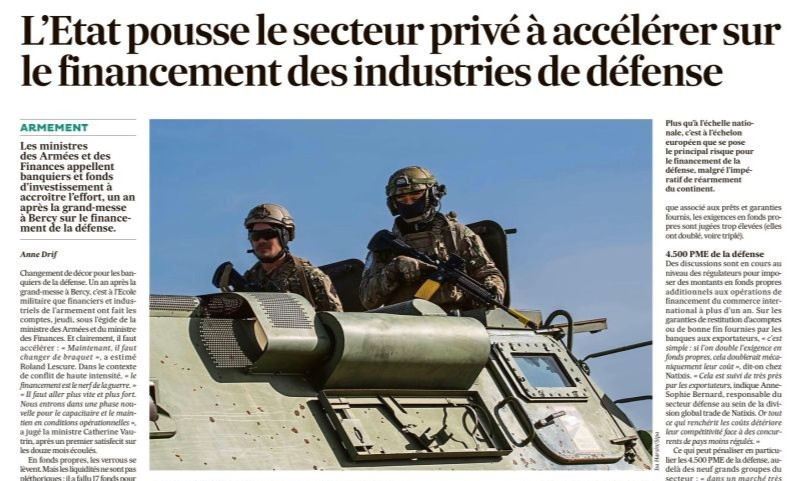
The European defense industry is entering a new phase of development. After several years of steadily increasing military budgets, manufacturers are now facing a different challenge: being able to rapidly finance the expansion of their production capabilities.
A recent article published by the French newspaper Les Échos highlights the French government’s appeal to banks, insurers and investment funds to step up financing for the defense sector. This mobilisation of private capital reflects a broader economic reality: investment requirements now far exceed the capacity of traditional bank financing alone.
To meet the growing volume of orders from European governments, companies must invest simultaneously across several areas:
Yet these investments must be made well before the associated revenues are fully realized.
As a result, the challenge is no longer purely commercial or technological. It is increasingly a financial one.
Historically, the European industrial sector has relied primarily on bank lending for its financing needs.
While this model remains essential, it has certain limitations when it comes to supporting large-scale industrial programs that require substantial funding and long-term investment plans.
Prudential regulations, sector risk concentration and capital adequacy requirements are leading banks to apply more selective criteria when evaluating financing opportunities.
This situation is particularly challenging for small and medium-sized enterprises (SMEs), which form a critical part of the European defense value chain.
In this context, asset-based financing is attracting growing interest.
Unlike approaches that rely solely on a company’s financial ratios, this financing model is based on the value of the industrial assets themselves, including production equipment, strategic inventories and other operational assets.
This approach enables manufacturers to access additional sources of funding without necessarily increasing their reliance on traditional bank credit facilities.
As a result, asset-based financing is particularly well suited to capital-intensive industries, where tangible assets play a central role in value creation.
While the defense sector is currently acting as a catalyst for this shift, the trend extends across the broader European industrial landscape.
Industries such as energy, environmental transition, infrastructure, materials and manufacturing face similar challenges: financing strategic assets while preserving borrowing capacity.
This evolution is contributing to the emergence of a more diversified financing ecosystem, bringing together banks, private debt funds, insurers and asset-based finance specialists.
The question is no longer whether private capital will play a role in financing Europe’s reindustrialisation, but rather in what form.
The companies that will succeed in accelerating their growth will likely be those able to combine multiple financing solutions tailored to their assets and operational requirements.
In this environment, industrial finance specialists play an increasingly important role by connecting investors and manufacturers around tangible, value-generating assets.
This trend is already evident in the European asset-based finance market, where specialised firms such as Chetwode have spent more than two decades supporting SMEs and large industrial groups in structuring financing solutions backed by equipment and inventory.
As industrial sovereignty becomes an economic and strategic priority, the ability to transform industrial assets into financing tools could become one of the key drivers of competitiveness for European companies in the years ahead.